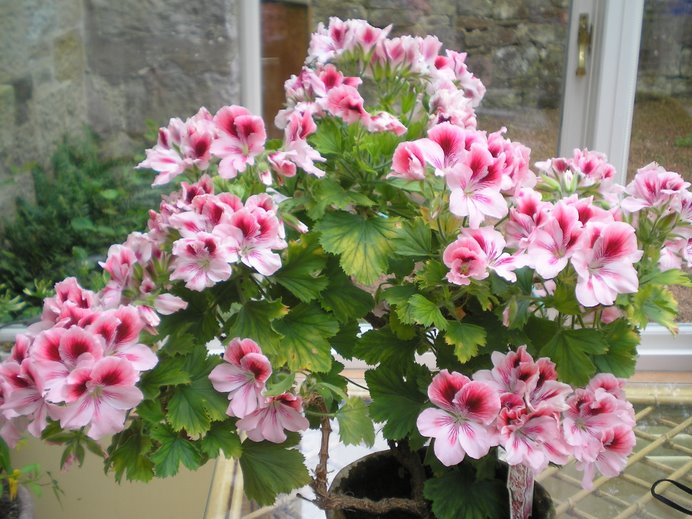
I am not really very good at house plants, but I do have some successes.
Of the ones that were mentioned in the comments on the last blog:-
Cyclamen. Some survive, some I lose. When they are new, the secret is to keep them moist but not over-wet. If they dry out, they fall outwards and do not come up properly again, even if watered soon enough. If overwatered they will just gradually give up the ghost. There is much talk about not getting the top of the corm wet and watering from the bottom. I have never bothered about that, and I don't think it matters, if you tip any excess water out of whatever they are standing in if you have given them too much and the conditions in the room are correct. This house is more likely to be too cold than hot. It is frost free though. If there is a radiator, I keep the cyclamen well away from it, (this goes for most plants). As they are in bloom in winter, the sun is not a problem and they do like plenty of light. I pull out flowers that are dying, hoping to get the whole stem.
If the plant is worth it, I keep it in the greenhouse after it has flowered. This does not get as much light as it should, which in summer suits cyclamen. Watering goes on as before - only when needed but do not alow to dry out. Now comes the "don't know" bit! I have allowed them to dry/go dormant during the summer - about June to September - and also kept them going all year. I think the natural way is to let it go dorment. Either way, for me, they go leafless or nearly at some point and then start up again. The old one in the picture was certainly allowed to take its own course this year. Can't remember how long I have had it or whether it has ever had the dry-out-under-the-bench treatment. If it had it would have been repotted in nice new compost in September. I do not bring them into the Conservatory until they have several flowers out and plenty of buds. I do not try to keep them in the house proper for two reasons - I forget to water them and the conditions are not as good.
Poinsettia - Make sure that the shop wraps the plant so that not a breath of a draft can get at it. When you get it home, put it in a draft-free place. Not too much light. I haven't got one this year but if I had it would be on the kitchen table against the wall with very little natural light. There is an electric light above it which is on quite a lot - enough apparently as it then lasts from before Christmas to about Easter, though by then it has lost most of its leaves. It needs to be kept just moist, not wet. It must not dry out though. Either way it would drop all its leaves. I do not try to grow them on afterwards. The Christmas ones have been grown in specialist conditions, with the amount of light per day very carefully controlled, as this and temperature decide when it will produce its red (or yellow) bracts. Not flowers - they are the tiny things in the centre. On Gardeners' Question Time, you will find that they all turn up their noses, whoever is on, because the plant is so fussy. Huge quantities are produced, presumably because a well grown plant does look very Christmassy. Very few survive more than a few days!
Other queries were:-
Wizzard - the plant in picture 6 down is Hebe Crystal. It, or its near relations are quite common. I saw one in Suffolk that was about 8ft tall but I think this one is not as vigorous. It could be controlled by pruning, anyway. It is very good value because it flowers from about August/September to early Spring.
Tiggy - What bulbs?!!! Usually there are lots poking through by now, even up here, but this year there are hardly any. I do not have any really early snowdrops, perhaps I should get some.
Frances - We are as far north as you can get in England, almost, only Crystal and @themill are further up. Scotland is another matter, of course - run from the chain-saw! We are at 650 feet, which is quite high, and very exposed to the wind, though we do have a wind-break to the West. Very open to the East, only a stone wall which doesn't really help much. The temperature gets down to -4 or -5 on the house wall, quite a lot lower out in the open, I should think. In the past this used to happen quite often and we had lots of snow. Now not so often and much less snow. This winter has been colder though. Highest shade temperature reaches 24 or even 25.
Friday, 2 January 2009

Thursday, 1 January 2009
Colour in the garden on New Year's Day
Today, I went looking for colour.
First I looked in the Conservatory. This cyclamen I have had for a number of years, forget how many.

This one was given to me by the staff at the School at the end of term. They seem grateful for the small amount that I do for them

First I looked in the Conservatory. This cyclamen I have had for a number of years, forget how many.
This one was given to me by the staff at the School at the end of term. They seem grateful for the small amount that I do for them

Then I went to the Greenhouse. the Azalea is the one that I took 2 years running when I started my blog. It gets ever bigger but does not flower as well as it used to.

Very much the tail end for these Fuschia. They will have to be cut hard back soon.

These Streptocarpus (is that the right name?) have been in flower since spring but are tailing off now. I shall remove the leaves that have had flowers growing from them soon. Many have gone already


Very much the tail end for these Fuschia. They will have to be cut hard back soon.

These Streptocarpus (is that the right name?) have been in flower since spring but are tailing off now. I shall remove the leaves that have had flowers growing from them soon. Many have gone already

Now we veture out into the gloomy day. (The sun came out later but I couldn't be bothered to go out again!) This Hebe appears in the last blog but it is looking a bit part worn after the long cold spell and snow.

You do not need flowers to give you colour. These pictures show evergreen foliage, some variegated, some gold and some stem colour. Also a different Hebe with small white flowers in the second picture.

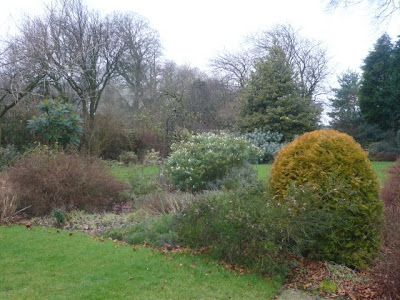

You do not need flowers to give you colour. These pictures show evergreen foliage, some variegated, some gold and some stem colour. Also a different Hebe with small white flowers in the second picture.


And lastly, gold and green

Tuesday, 9 December 2008
Frozen Flowers to lift the Spirit
In amongst all our sadness for Sam, after losing her beloved husband Richie, I am posting these pictures of brave flowers that have weathered extreme cold and snow in our Northumberland garden and are still there to cheer us.
 These are Old English roses, Graham Thomas, that often go on flowering until Christmas.
 This rose, growing on the house wall, was planted a very long time ago. It is a once-a-summer flowerer. What is it doing flowering now?
 This orange-berried Pyracantha is keeping its food for the birds for a little while yet.
 Here you can see what last night brought - freezing fog. Proper colour of the flowers is there in the middle.

And this brave fellow, Hebe Diamond, will flower most of the winter. I love it for that.

This did its flowering proper in the summer, as it should. Now it is doing it all over again in this inclement weather.
 Here is one of G's roses - sooo beautiful.
These are Old English roses, Graham Thomas, that often go on flowering until Christmas. This rose, growing on the house wall, was planted a very long time ago. It is a once-a-summer flowerer. What is it doing flowering now?
 This orange-berried Pyracantha is keeping its food for the birds for a little while yet.
 Here you can see what last night brought - freezing fog. Proper colour of the flowers is there in the middle.
And this brave fellow, Hebe Diamond, will flower most of the winter. I love it for that.

This did its flowering proper in the summer, as it should. Now it is doing it all over again in this inclement weather.
 Here is one of G's roses - sooo beautiful.
Thursday, 4 December 2008
Snow and Church
A trip up to the Church, to see how the heating was working - it seemed great, but what will the cost be?

 The view as I started down the hill again
 Church gate to House gate.
 Two pictures, taken in the garden:

 Two lovely people who live next door:
 Where is that food I thought you had?
 Move over, I want it! Oh, you blurdy cheat, it is only a camera!


Here we see it sparkling clean after lots of hard work!
The view as I started down the hill againChurch gate to House gate.Two pictures, taken in the garden: Two lovely people who live next door:Where is that food I thought you had? Move over, I want it! Oh, you blurdy cheat, it is only a camera!
 Sunday, 31 August 2008
Fund-raising Day
 Picture taken by Our Lovely Lady Vicar!
What a day! We started with a Benefice Eucharist - attended by 30 + people, a lot for our little church. S0me were normal church-goers, some were Methodists from the village, some were visitors from round about and there was the odd Roman Catholic too. The singing was great and Jerusalem lifted the roof! I shall not comment on the sermon because I know that our lovely lady vicar has sussed me out and will, without doubt, read this!!! (I need emoticons on the blogs!)
From the church, we moved across the Village Green to the Women's Institute Hut for a fund-raising lunch. At first we thought that we were short on numbers but late on others arrived and we were washing up the odd plate to accommodate the last 'extras'. We fed 46 and there was much left over - not sure how many baskets! At £10 a head, there was a good take there, don't you agree? The really amazing thing was that by the time the last guest departed for the Garden Fête, the tables were clear and the washing up had been done by teams of volunteers.
The earlier part of the afternoon was dry. People rolled up from up and down the Tyne Valley, having seen an advert in the local paper, The Hexham Courant. Apparently it was raining heavily there about lunch time, so it was only dedicated garden lovers who turned out. However, trade in the Gazebo was brisk and cakes, books and bric-à-brac were snapped up, as well as raffle tickets. From there they graduated to the door-in-the-wall into the garden, where G was taking their entrance money. It gave me great pleasure that there were so many oohs and ahs to make all the hard work over many years really worth while. So often one enjoys one's garden in a solitary way and to share it with so many is absolutely indescribable. From there they moved on to the Conservatory and 'Cream Teas'. These were fab - I had one later. A home-made scone, with plenty of strawberry jam and lots of whipped cream and a welcome cup of tea.
For me it was lovely to see so many stangers enjoying our garden and amongst them unexpected friends/aquaintences.
That was not all though. After the guests had mostly disappeared, the really lovely people who proved themselves and earned endless brownie points, set to, to help with the clearing up. Now the gazebo is empty and will hopefully be able to dry out tomorrow. The Conservatory is back to normal. All the plants that were left have moved on to be ready for the Kirhwhelpington Fête.
AND - the takings are in the region of £1200, which means that the WI Hut Appeal and the Kirkheaton Church Rewiring Fund are both about £600 better off.
Thursday, 14 August 2008
Bereavement Councelling
Two or three years ago, we set up a Local Ministry Group (LMG) in our United Benefice of three parishes. This is a requirement if someone wants to become a Locally Ordained Minister.One of our members soon came forward for this and after a gruelling 2 years, she is embarking on the third and last. She has practiced as a doctor for many years, and a few years ago trained to become a Councillor, in all sorts of disciplines, including bereavement.
A group of Bereavement Councillors was set up in the Upper Coquet valley a few years ago and this is gradually extending to cover more and more of North Northumberland, right up to Berwick.
I am a member of our LMG and it was mentioned about a year ago that there would be a chance of training anyone from this Benefice, if anyone was interested. Several thought about it but they have pulled out for the time-being for various personal reasons. It seems that I am the only one left in, currently. I have been waiting since then for a chance to be trained.
On Wednesday, the existing group were having a refresher day and I was invited.
I wonder what the ordinary person thinks is meant by Bereavement Counselling. I imagined it meant listening to people releasing their feelings, after losing someone close to them. Beyond that I did not know.
After the session on Wednesday, I realise that listening is very important but there is so much more. Not just what is done to help the person, (I hate the word client), but also how to start, finish, cope yourself, etc etc. We started with a session during which they went through things they had found good - like a genuine smile - and things they had found hard. The latter part threw up all sorts of things that made me realise how difficult it could be at times. The innitial listening is the 'easy' part if you can get them to really talk about the things that matter, that is!
After coffee, we split into 3's and fortunately were able to use 3 different spaces. The leader/facilitator floated between the groups, listening to how they were getting on.
Two chairs were placed facing each other, with a third to the side for the Observer. The other two were for the talker and the listener. Having been warned not to choose anything too recent, were asked to speak about a personal bereavement and I waa asked to go first. I decided to talk about my Mother who died 15 years ago. It was surprising how real this became for me once I was launched into my account - and very emotional. I had never talked about it but do think about it sometimes and I remembered it as if it was yesterday. It did seem a little strange at first to have the Observer there, but I soon forgot about her and talked directly to the listener, who kept very still and did not interrupt until near the end (we had had the 2 minute warning!) when she asked a question. At the end the Observer made her comments and we talked about it a bit. Then we played musical chairs and I was in the observers place. The trained councellor was the listener, so I was able to watch and observe her as she listened to a very traumatic story. I had to try to distance myself from that because my job was to comment on the Listener. This was good practice, because whilst taking it all in etc, one must keep oneslf one step removed when doing the real thing. Musical chairs again and I became the Listener. I got 'good marks' for body language and attention and non-interruption and the question I asked at the end!
We gathered again in the main room and shared a few things that had come out of the excersise, before eating the pooled lunch and chatting about holidays in France and India and other things to relieve our minds after quite a gruelling morning.
After lunch we revisited the problems, available facilities etc and lots of new things came up in the discussion. By this time, I had enough confidence to ask a few questions myself and even make a comment which hit a nail on the head!
By the time we broke up and headed for home, I was shattered! However the drive through the glorious Northumbrian countryside, in the only bit of sun of the day (week?) rested my mind and I was fine by the time all the young rang me to wish me a happy birthday.
Now it is decision time. I know that I would like to train further and take up this very worth while job. But I have questions to answer for myself. Will the time that I will have to be out be unfair on G? How much stress will this put on me, especially if I get a hard case? Will I be able to cope? And most important of all - these will be real human beings I will be trying to help and am I capable of doing a good job? It would be so easy to make matters worse, with the wrong comment or approach. I must talk to the trained Councellor, but she cannot make the decision.
Also I do not know when I will be able to get further training, and time, tide and old age wait for no man!
I will keep you posted!
A group of Bereavement Councillors was set up in the Upper Coquet valley a few years ago and this is gradually extending to cover more and more of North Northumberland, right up to Berwick.
I am a member of our LMG and it was mentioned about a year ago that there would be a chance of training anyone from this Benefice, if anyone was interested. Several thought about it but they have pulled out for the time-being for various personal reasons. It seems that I am the only one left in, currently. I have been waiting since then for a chance to be trained.
On Wednesday, the existing group were having a refresher day and I was invited.
I wonder what the ordinary person thinks is meant by Bereavement Counselling. I imagined it meant listening to people releasing their feelings, after losing someone close to them. Beyond that I did not know.
After the session on Wednesday, I realise that listening is very important but there is so much more. Not just what is done to help the person, (I hate the word client), but also how to start, finish, cope yourself, etc etc. We started with a session during which they went through things they had found good - like a genuine smile - and things they had found hard. The latter part threw up all sorts of things that made me realise how difficult it could be at times. The innitial listening is the 'easy' part if you can get them to really talk about the things that matter, that is!
After coffee, we split into 3's and fortunately were able to use 3 different spaces. The leader/facilitator floated between the groups, listening to how they were getting on.
Two chairs were placed facing each other, with a third to the side for the Observer. The other two were for the talker and the listener. Having been warned not to choose anything too recent, were asked to speak about a personal bereavement and I waa asked to go first. I decided to talk about my Mother who died 15 years ago. It was surprising how real this became for me once I was launched into my account - and very emotional. I had never talked about it but do think about it sometimes and I remembered it as if it was yesterday. It did seem a little strange at first to have the Observer there, but I soon forgot about her and talked directly to the listener, who kept very still and did not interrupt until near the end (we had had the 2 minute warning!) when she asked a question. At the end the Observer made her comments and we talked about it a bit. Then we played musical chairs and I was in the observers place. The trained councellor was the listener, so I was able to watch and observe her as she listened to a very traumatic story. I had to try to distance myself from that because my job was to comment on the Listener. This was good practice, because whilst taking it all in etc, one must keep oneslf one step removed when doing the real thing. Musical chairs again and I became the Listener. I got 'good marks' for body language and attention and non-interruption and the question I asked at the end!
We gathered again in the main room and shared a few things that had come out of the excersise, before eating the pooled lunch and chatting about holidays in France and India and other things to relieve our minds after quite a gruelling morning.
After lunch we revisited the problems, available facilities etc and lots of new things came up in the discussion. By this time, I had enough confidence to ask a few questions myself and even make a comment which hit a nail on the head!
By the time we broke up and headed for home, I was shattered! However the drive through the glorious Northumbrian countryside, in the only bit of sun of the day (week?) rested my mind and I was fine by the time all the young rang me to wish me a happy birthday.
Now it is decision time. I know that I would like to train further and take up this very worth while job. But I have questions to answer for myself. Will the time that I will have to be out be unfair on G? How much stress will this put on me, especially if I get a hard case? Will I be able to cope? And most important of all - these will be real human beings I will be trying to help and am I capable of doing a good job? It would be so easy to make matters worse, with the wrong comment or approach. I must talk to the trained Councellor, but she cannot make the decision.
Also I do not know when I will be able to get further training, and time, tide and old age wait for no man!
I will keep you posted!
Monday, 11 August 2008
The Food Flying Squad
Most of you will know what the Women's Royal Voluntary Service is.
Just before the war, Lady Reading was asked to mobilise the women of the country into a voluntary force. Many were called up or went to nurse, but there were a great many who had to stay at home to look after families etc. They flocked to her banner and were taught to do all sorts of things, one being driving ambulances, which they did in London during the blitze to great effect. Go to http://en.wikipedia.org/wiki/WRVS to find out more.
After the war (I think) the Food Flying Squad was founded, to do exactly what it said - get food quickly to where it was needed in an Emergency. I joined in 1956 and what fun we had! We had a fleet of lorries and I had to get an HGV licence (of a sort). Driving these things involved double de-clutching which is something all you babies have probably never heard of! We had a stores lorrie, 2 food lorries and a water tanker, as far as I can remember. We carried evil stove things - can't remember what they were called - which had to be lit and kept going to boil water. Also we built the original form of a barbeque - a sort of box built of whatever you could find that was fire-proof, with a grid over. We could produce sausages etc and also stew which was cooked on the stove thingie.
I was made Transport Officer and so had to learn the basics of engines, putting in anti freeze, changing wheels etc. We also had a tent and I remember shinning up the tent pole to get a toggle over the top if it, to the astonishment of the rest of the group who were all much older than me! Thankfully, we never had to go to a real emergency, but I remember feeding the police at the wedding of the Duke and Duchess of Kent. They were married in York and the reception was at Hovingham so there was an awful lot of road to patrol. We got to see the cars go by - whoosh and they were gone! We were based near Hovingham and as our home was Croft-on-Tees, we had quite a drive and had to get up onto the hills. We did not try to go up Sutton Bank (1 in 5 slope, I seem to remember) so we had to go down to Ampleforth. Sorry about the geography - only a few of you will follow it I fear.
The WRVS Emergency Service does much the same as we did but does not have a fleet of lorries! You will have heard of them in this country, attending things like the Tube bombing, the Lockerby air crash, floods and many other things.
Just before the war, Lady Reading was asked to mobilise the women of the country into a voluntary force. Many were called up or went to nurse, but there were a great many who had to stay at home to look after families etc. They flocked to her banner and were taught to do all sorts of things, one being driving ambulances, which they did in London during the blitze to great effect. Go to http://en.wikipedia.org/wiki/WRVS to find out more.
After the war (I think) the Food Flying Squad was founded, to do exactly what it said - get food quickly to where it was needed in an Emergency. I joined in 1956 and what fun we had! We had a fleet of lorries and I had to get an HGV licence (of a sort). Driving these things involved double de-clutching which is something all you babies have probably never heard of! We had a stores lorrie, 2 food lorries and a water tanker, as far as I can remember. We carried evil stove things - can't remember what they were called - which had to be lit and kept going to boil water. Also we built the original form of a barbeque - a sort of box built of whatever you could find that was fire-proof, with a grid over. We could produce sausages etc and also stew which was cooked on the stove thingie.
I was made Transport Officer and so had to learn the basics of engines, putting in anti freeze, changing wheels etc. We also had a tent and I remember shinning up the tent pole to get a toggle over the top if it, to the astonishment of the rest of the group who were all much older than me! Thankfully, we never had to go to a real emergency, but I remember feeding the police at the wedding of the Duke and Duchess of Kent. They were married in York and the reception was at Hovingham so there was an awful lot of road to patrol. We got to see the cars go by - whoosh and they were gone! We were based near Hovingham and as our home was Croft-on-Tees, we had quite a drive and had to get up onto the hills. We did not try to go up Sutton Bank (1 in 5 slope, I seem to remember) so we had to go down to Ampleforth. Sorry about the geography - only a few of you will follow it I fear.
The WRVS Emergency Service does much the same as we did but does not have a fleet of lorries! You will have heard of them in this country, attending things like the Tube bombing, the Lockerby air crash, floods and many other things.
Subscribe to:
Posts (Atom)